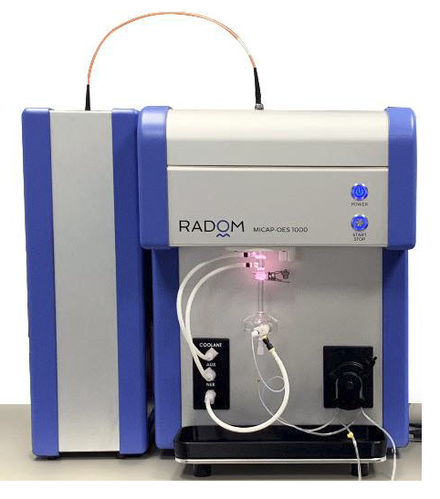

Gc-ms
Single-Quadrupole GC/MS
GC-MS – the classical principles of mass-spectrometry expressed with innovative technologies.
Highly efficient system configuration to achieve maximum sensitivity

Innovative design solutions and modern materials and technologies allowed us to develop the novel type of inert ion sources
Ion sources operate at high emission current values, which allows for high ion currents. At the same time, the high purity and quality of the materials used, as well as new technological solutions make the ion source reliable and inert even to complex biological extracts.
Conventional ion source Inert ion source
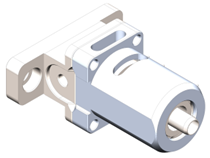
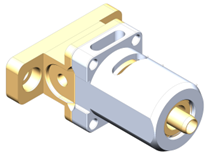
- The unique isothermicity of the source ensures high ionization efficiency of non-volatile compounds, which provides an improved response for active and late-eluted compounds;
- The innovative use of ceramic material ensures that the source is inert even to complex biological matrices. This source requires less maintenance than conventional ion sources;
- A special layer of ceramic inner surface ensures high ionization efficiency of nitro compounds.
 Trifluralin compound response for the inert source.
Trifluralin compound response for the conventional ion source.
Stability of the ion current signal during multiple injections of complex biological matrix extract of fermented milk products with a high fat content.(App Note-11/2019GCMS)
Stability of ion signals is one of the most important parameters when working with mass spectrometric detectors in a complex matrix. Usually Electron Impact ion source prone to contamination is the most vulnerable element of the system, as the design of such sources is usually “closed type”. This design makes it possible to further concentrate the sample components in the source and thus achieve the level of trace concentrations.
The inert source of the GC-MS system is resistant to samples with a high content of matrix components and does not require frequent maintenance. To demonstrate excellent robustness of the ion source we used samples from a routine laboratory. We repeatedly injected extracts of cottage cheese and butter into GC-MS, followed by injection of diphenylamine standard. Comparison of the diphenylamine peak areas at the beginning of the experiment and after more than a hundred injections of fermented milk extracts indicates the absence of contamination of the ion source.
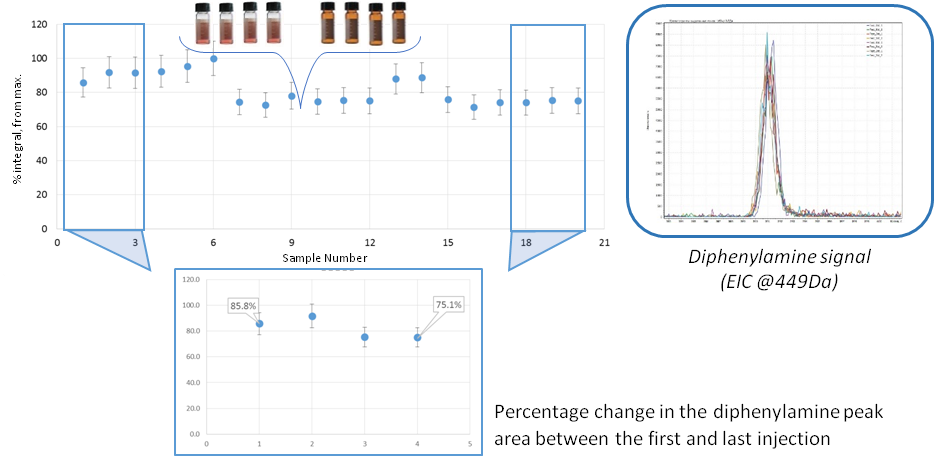
The results of the study demonstrate the stability of the ion current peak area over many infections.
Using hydrogen as a carrier gas
Usually, in gas chromatography-mass spectrometry, helium is used as a carrier gas.
However, over recent years, the use of hydrogen as an alternative carrier gas has increased due to the high and growing cost of helium, the inconveniences of dealing with gas bottles and a number of other significant advantages.
The advantages of using hydrogen are as follows:
- the speed of chromatography significantly increases (due to the higher linear velocity of the hydrogen carrier gas, compared with helium);
- therefore, the time for one analysis is reduced;
- hydrogen can be produced by a hydrogen generator;
- Besides, hydrogen is known to maintain emission properties of the electron multiplier, thus extending its lifetime.
The design of the ion source of the mass detector is optimized for both helium and hydrogen as a carrier gas and does not require modification or replacement of any ion source hardware components. Thorough testing have shown excellent reliability, safety and reproducibility of the MS-detector when using hydrogen as a carrier gas.
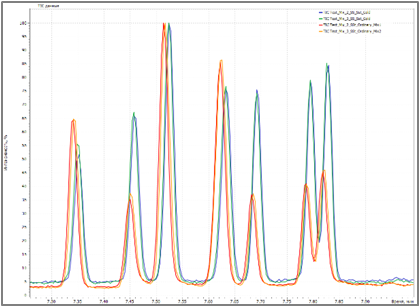
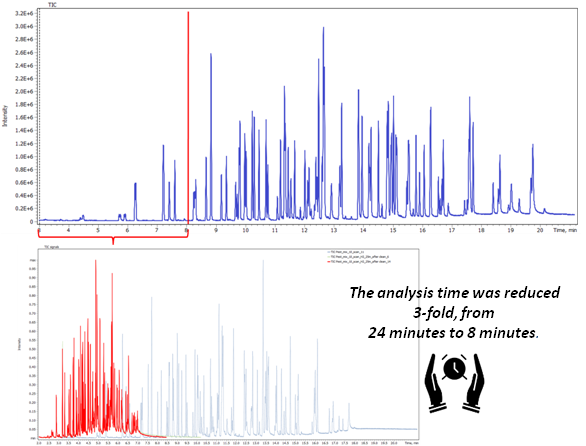 Using hydrogen as a carrier gas, made it possible to successfully separate more than 75 pesticide compounds in less than 8 minutes, with the sensitivity of the method at 5 ppb (App Note-11/GCMS2019)
S-filter provides complete removal of photon noise and reliable focusing of the ion beam into a quadrupole mass filter
In all GC-MS systems, electron impact ion sources use filaments, which in addition to emitting electrons, also form neutral particles such as photons. The presence of such particles for a mass spectrometric detector result in high background noise in the spectrum.
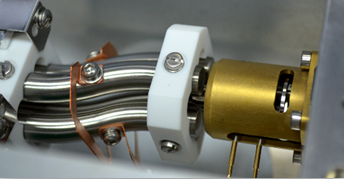
The S-filter forms a retaining electric field that allows deflecting charged particles from the trajectory and thus filtering neutral particles away. Thus, only charged particles, in particular the ions formed in the ion source, go into the quadrupole and then onto the detector.
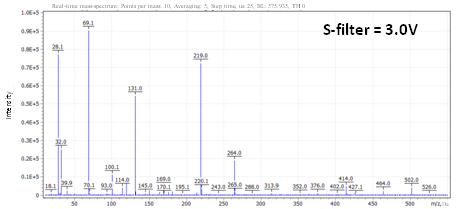
Changing the voltage on the S-filter allows operator to further adjust signal intensity over different ranges of analyzed masses.
1. During the auto-tuning process, the algorithm automatically detects points of optimal S-filter voltage.
2. Say, when measuring over typical mass range, the S-filter can push low residual gas signals, thus eliminating distortion of the resulting spectrum in the case of dirty carrier gas. While the mass response ratios in the spectrum are preserved, as shown in the figures below. This feature allows operator to get a high score of library match of the studied spectrum and confident identification of unknown analyte.
Autotune S-filter parameter
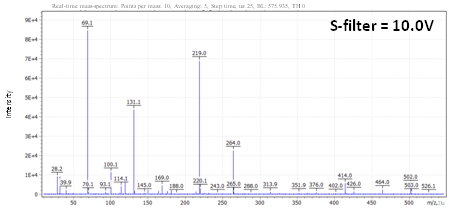
Manual S-filter adjustment to raise signal intensity over mass range of residual gases
High-precision quadrupole filter design for separating ions by their mass-to-charge ratio
The quadrupole is formed by four rods, which are located symmetrically relative to the common Central axis.
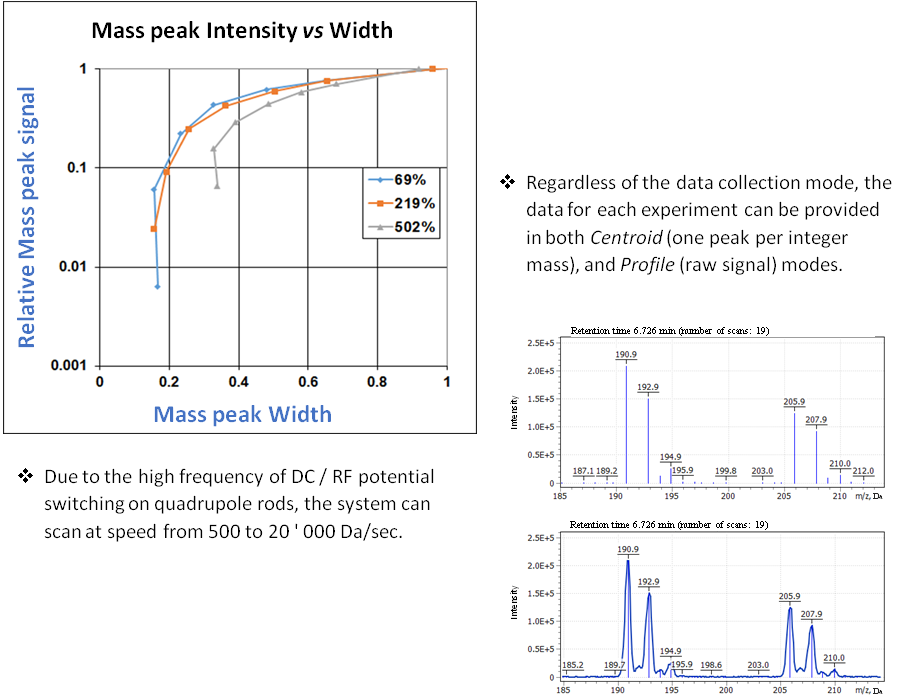
The utmost precision fabrication of the quadrupole rods and the proven technology of precise assembly, permit to hold a high-intensity ion beam even with a mass-peak width below 0.4 Da.
The peak intensity varies insignificantly up to a mass peak width of 0.4 Da.
System Specifications
System technical specifications:
- Mass range: 2 – 1200 amu.
- Scan rate: upto 20000 amu/sec
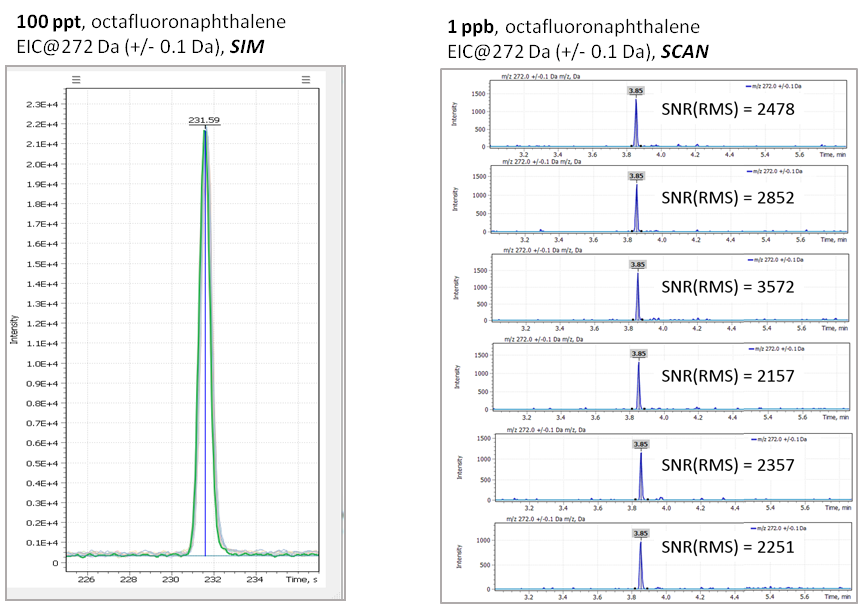
- SCAN sensitivity: SNR > 1500:1 (OFN@272)
- SIM sensitivity: IDL < 10 fg (OFN@272)
- Linear dynamic range: 5^106
- Mass axis stability: < 0,1 amu/48 hrs
- Turbomolecular pumps: 75 L/sec or 300 L/sec
- GLP features: OQ/IQ/PV protocols available
Easy-to-use, state-of-the-art software with highly automated auxiliary algorithm architecture
- “Easy to use” – is a fundamental principle that has been used in development of software.
- The software combines many automatic algorithms for configuring ion scanning methods to achieve maximum sensitivity and quality of data, as well as many automatic algorithms for processing the acquired data.
- The software works under Windows, Linux, and Apple operating systems.
- The software is designed to be translated into different languages.